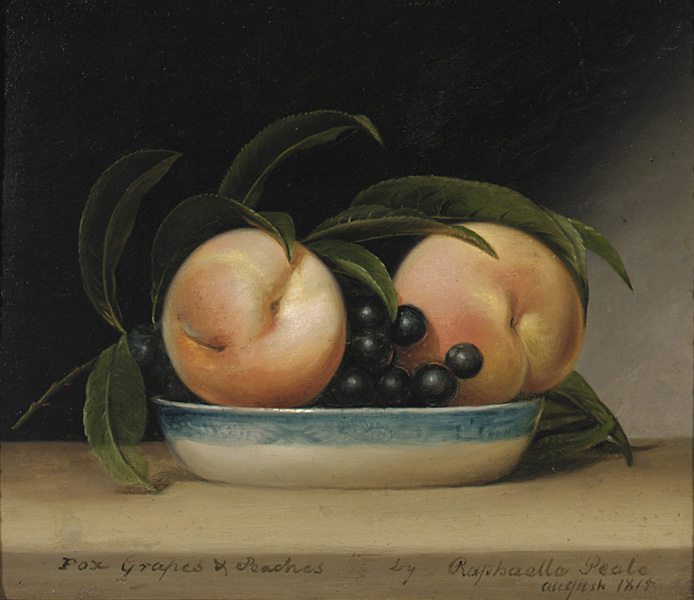
Fox Grapes and Peaches
Raphaelle Peale
Although now frequently considered the most talented of Charles Willson Peale's sons, Raphaelle Peale had the unhappiest life of all his children. A painful case of gout (possibly caused by exposure to mercury and arsenic preparing taxidermied specimens for his father's museum) hobbled Peale's ability to make a living painting portraits and miniatures. He was compelled to develop his affinity for still-life painting into a career during an era when such works were dismissed as lesser, 'amateur' expressions of the painter's art; as such, Peale struggled financially throughout his short life. His illness, poverty, alcoholism, troubled marriage, and irrational behavior were a strain on his solicitous father and more successful younger brother Rembrandt.
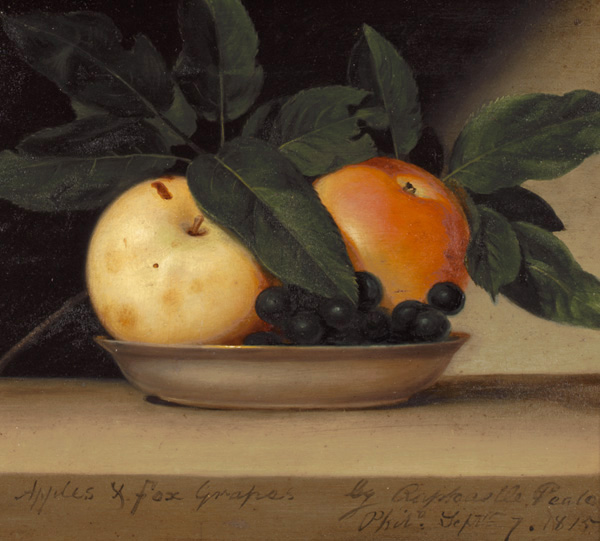
Beloved for his sense of humor, Raphaelle Peale enjoyed creating visual puns through 'trompe l'oeil' painting. His still lifes of fruit, on the other hand, tend to be more meditative images, less concerned with fooling the eye than paying full attention to the beauty of nature's bounty, including its imperfections, such as the knife gash in one of these delicately painted peaches. Peale exhibited in the Academy's annuals almost every year from 1811 until his death (and like many artists was represented by loaned works for years thereafter). This painting, and a companion piece, "Apples and Fox Grapes," were shown at the 1816 annual, and are thought to have been purchased by the Academy at the time.
Artist
Date of Birth
(1774-1825)
Date
1815
Medium
Oil on wood
Dimensions
9 11/16 x 11 7/16 in. (24.60625 x 29.05125 cm.)
Accession #
1845.6
Credit Line
Source unknown (probably Pennsylvania Academy purchase, 1817)
Copyright
No known copyright restrictions
Category
Subject
We're so excited you're planning to visit PAFA!
Make time for art — visit us Thursday to Sunday.
Before reserving your tickets, please review helpful information about museum hours, accessibility, building access, and special admission programs.
If you have any questions, feel free to reach out to us at visitorservices@pafa.org — we’d love to help!