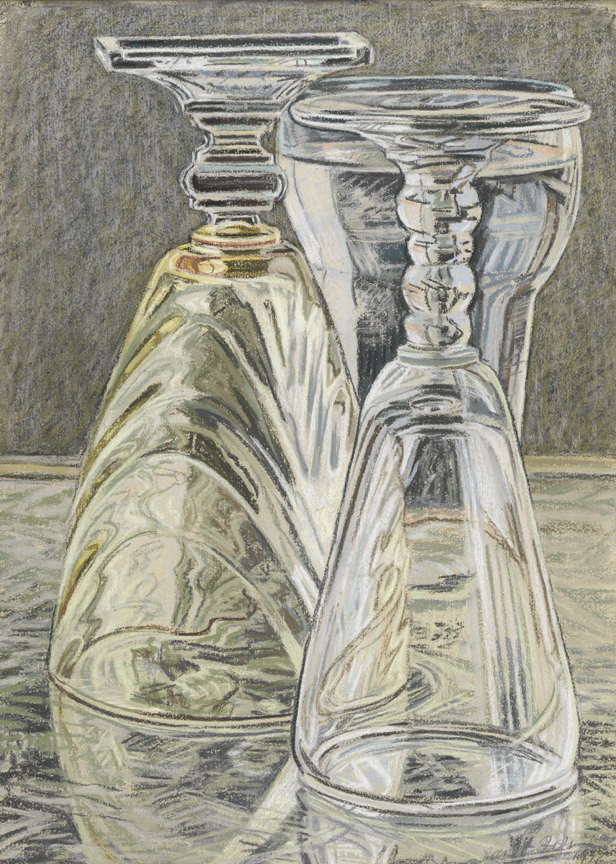
Yellow Goblets
Janet Fish
Often connected with the New Realist movement of the 1970s, Janet Fish is best known for her lustrous still lifes incorporating fruit jars, plates, vases, goblets, and other glassware. Born in Boston, Fish was raised in an artistic family. She spent her childhood with her grandfather, the landscape painter Clark Voorhees, in Old Lyme, Connecticut, the location of an art colony associated with American Impressionism. Her mother was a sculptor, and Fish aspired to be a sculptor too, first studying at Smith College with Leonard Baskin before attending Yale University, where she experimented in abstract painting.
Fish's still lifes frequently show an almost Pop Art playfulness in their elevation of mundane household objects to shimmering treasures, but her work is also influenced by the highly personal vision of Abstract Expressionism. Unlike the idealized, classical still lifes of William Bailey, Fish combined meticulous observation with a sensuous application of paint, while also offering personalized settings for her everyday objects. The properties of glass provide Fish with endless opportunities to explore unique abstracted forms and a rich and seemingly unlimited spectrum of jewel-like color. "Yellow Goblets" masterfully replicates the illusion of overlapping transparent glass, especially notable for the fact the Fish created the image using chalk pastel, the physical antithesis of the hard, glaring surface of glass.
Artist
Date of Birth
(b. 1938)
Date
1976
Medium
Pastel and wash on white wove paper
Dimensions
31 1/4 x 22 3/16 in. irr. (79.375 x 56.35625 cm.)
Accession #
1976.14.3
Credit Line
Funds provided by the National Endowment for the Arts, the Charles E. Merrill Trust and the Crag Burn Fund
Copyright
© Janet Fish / Licensed by VAGA at Artists Rights Society (ARS), NY
Category
Subject
We're so excited you're planning to visit PAFA!
Make time for art — visit us Thursday to Sunday.
Before reserving your tickets, please review helpful information about museum hours, accessibility, building access, and special admission programs.
If you have any questions, feel free to reach out to us at visitorservices@pafa.org — we’d love to help!