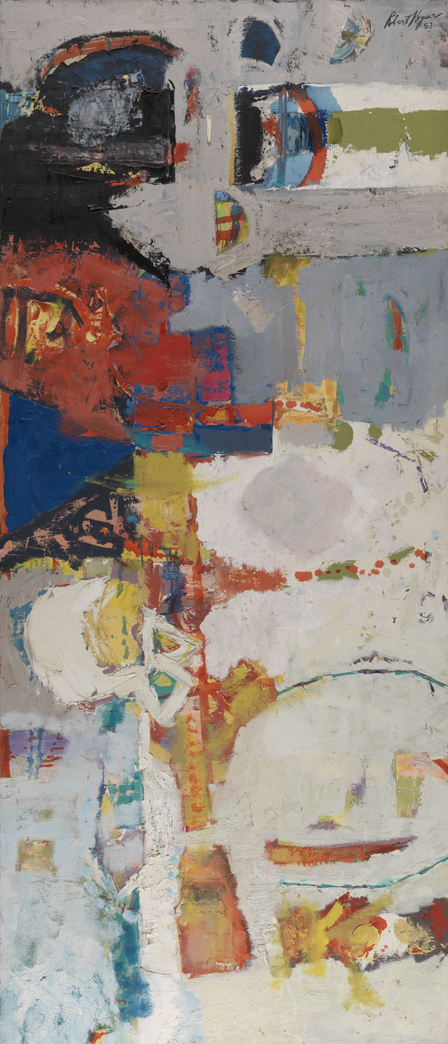
Vertical Growth
Robert Keyser
This painting demonstrates Keyser's early development as an abstract painter which emphasized thick impasto - the application of paint with both brushes and putty knives. While undoubtedly under the influence of the New York School (Keyser was in fact living in New York at this time), this work cannot be seen as being completely derivative. It was Keyser's Abstract Expressionist work that caught the attention of the important modernist dealer, Paul Rosenberg and earned him the reputation as a minor but worthy figure in 1950's and 60s abstract painting.
"Vertical Growth," is characterized by a series of layers in which different approaches to the canvas are visible. For example, in the upper right quadrant beneath thick paint a more thinly painted area is visible. There is some subtractive methodology involved in Keyser's process as well. Layers of paint have been removed by both scratching and the use of broader, yet more superficial scraping techniques. There is evidence of much labor and thought in this process. Whereas eminent Abstract Expressionist Ex painters such as De Kooning and Pollack had a more gesture and spontaneous approach, "Vertical Growth," shows Keyser working in a very focused manner, reworking various sections of paint.
Artist
Date of Birth
(1924-1999)
Date
1957
Medium
Oil on canvas
Dimensions
54 7/8 x 23 5/8 in. (139.3825 x 60.0075 cm.)
Accession #
2003.11
Credit Line
Gift of Wally Reinhardt
Copyright
© artist or artist’s estate
Category
Subject
We're so excited you're planning to visit PAFA!
Make time for art — visit us Thursday to Sunday.
Before reserving your tickets, please review helpful information about museum hours, accessibility, building access, and special admission programs.
If you have any questions, feel free to reach out to us at visitorservices@pafa.org — we’d love to help!