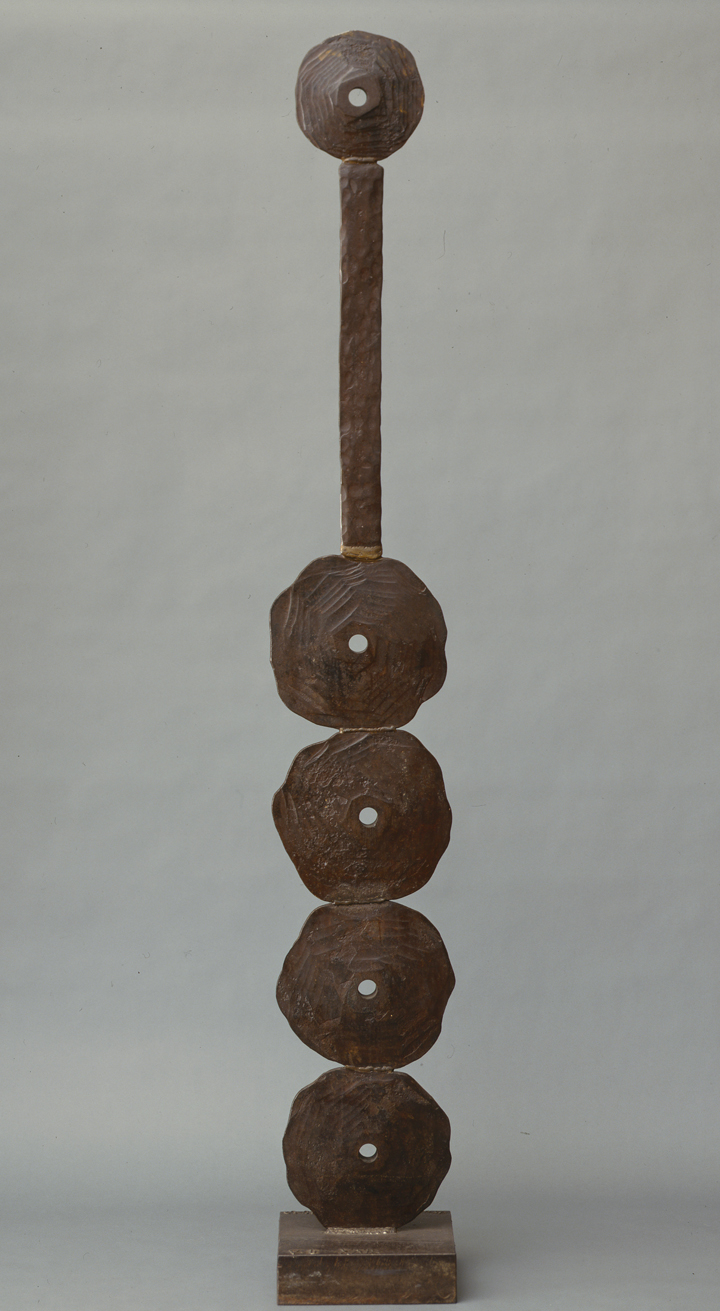
V.B. XXII
David Smith
Translating the gestural spontaneity of Abstract Expressionism painting into three dimension, Smith emerges as the leading sculptor of post-World War II America. Born in Decatur, Indiana, Smith moved to New York at the age of twenty one and enrolled in the art Students League, studying with the Czech abstractionist Jan Matulka. Upon seeing the welded sculptures of Pablo Picasso and Julio Gonzalez, Smith purchased welding equipment and began experimenting with the possibilities of industrial parts and tools for making art. The connection to industry also held a personal significance for Smith, as he had worked in an automobile plant as a young man and also assembled tanks and locomotives during World War II.
In 1952, after winning Guggenheim awards in two consecutive years, Smith began working in series, a process that he would continue until his death. "V.B. XXII" is from a series utilizing materials that Smith had shipped over from Voltri, Italy, to his Bolton Landing studio in upstate New York. Smith had visited Voltri the previous year, producing a series of large sculpture in an abandoned steel factory. The work conveys Smith's interest in evoking the totemic power of objects from past civilizations through the materials and techniques of the industrial world.
Artist
Date of Birth
(1906-1965)
Date
1963
Medium
Welded steel
Dimensions
99 5/8 x 14 1/4 x 13 in. (253.0475 x 36.195 x 33.02 cm.)
Accession #
1980.28
Credit Line
Gift of Mr. and Mrs. David N. Pincus
Copyright
© The Estate of David Smith / Licensed by VAGA at Artists Rights Society (ARS), NY
Category
Subject
More by
We're so excited you're planning to visit PAFA!
Make time for art — visit us Thursday to Sunday.
Before reserving your tickets, please review helpful information about museum hours, accessibility, building access, and special admission programs.
If you have any questions, feel free to reach out to us at visitorservices@pafa.org — we’d love to help!