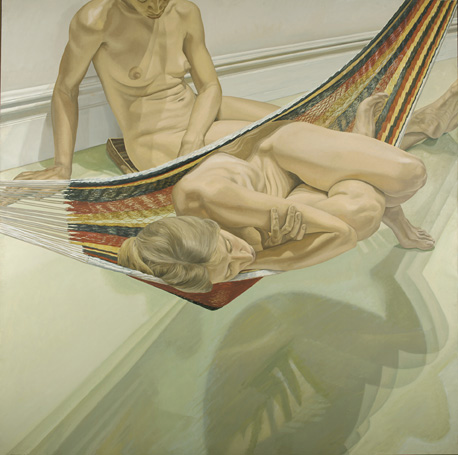
Two Female Models on Hammock and Floor
Philip Pearlstein
Philip Pearlstein was born in Pittsburgh and graduated from the Carnegie Institute in 1949, before moving to New York with his classmate and friend Andy Warhol. He gained recognition in the late 1960s and early 1970s for his starkly unidealized paintings of nude models in domestic settings. Pearlstein's pictures are often abruptly cropped and sport exaggerated perspectives. A classic example of the discrepancy between artistic intention and viewer reception, Pearlstein's paintings have been contextualized within European traditions of nude figure painting. Furthermore, his work has often been interpreted in sexual and psychoanalytic terms, given his choice of subject matter. However, Pearlstein claims that his allegiances lie in abstraction and formalism, not realism and the psychosexual. He characterizes his use of the nude as a convenient way to describe surfaces, contours, and their relationship to other forms. Pearlstein counters the emotional and spiritual transcendence associated with art and offers instead a visual and material discipline based on a rigorous matter-of-fact attitude. For these reasons, he has perhaps more in common with Conceptual and Minimal artists than with either Abstract Expressionists or fellow post war realists.
Artist
Date of Birth
(b. 1924)
Date
1974
Medium
Oil on canvas
Dimensions
72 x 72 in. (182.88 x 182.88 cm.)
Accession #
1983.21
Credit Line
Gift of Betsy and Frank Goodyear, Jr.
Copyright
© Philip Pearlstein / Artists Rights Society (ARS), New York
Category
Subject
![[Female model on African stool]](/sites/default/files/artworkpics/1975_17_1_l.jpg)
![[Nude on a Hassock]](/sites/default/files/artworkpics/1989_13_l.jpg)
We're so excited you're planning to visit PAFA!
Make time for art — visit us Thursday to Sunday.
Before reserving your tickets, please review helpful information about museum hours, accessibility, building access, and special admission programs.
If you have any questions, feel free to reach out to us at visitorservices@pafa.org — we’d love to help!