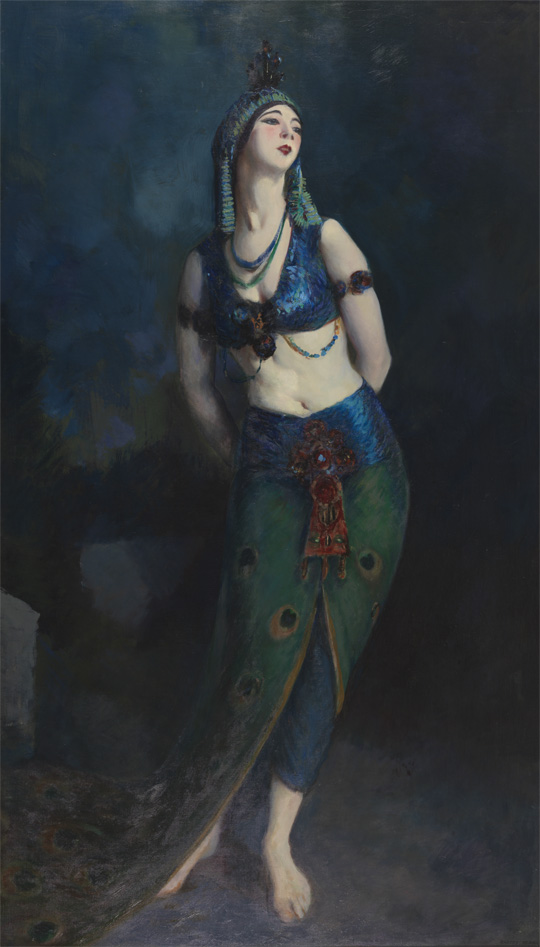
Ruth St. Denis in the Peacock Dance
Robert Henri
The driving force behind the formation of The Eight and the de facto leader of the so-called Ashcan School, Henri trained at the Pennsylvania Academy under Thomas Hovenden and Thomas Anshutz before seeking further study in Europe. Henri returned to Philadelphia in 1891 and embarked on his influential teaching career. While his crusading "art spirit" championed his students' freedom and experimentation, Henri's own work strayed little from his realist training. His greatest innovation was in painting contemporary scenes with an unflinching eye, even scenes considered ugly.
As with many of his compatriots among the Ashcan painters, Henri had an avid interest in the theater, evidenced by this striking full-length portrait of the celebrated modern dance pioneer Ruth St. Denis. Captivated by St. Denis's soon-to-be-legendary performance at New York's Palace vaudeville house, Henri asked the dancer to pose for what he called "a mighty propaganda." St. Denis's choreography was frequently inspired by non-Western sources, and she based this role on an Indian legend of a woman who is turned into a peacock because of her extreme vanity. Henri painted St. Denis in her exotic costume of shimmering violet and green, her sinuous pose reflective of the dance's graceful movement.
Artist
Date of Birth
(1865-1929)
Date
1919
Medium
Oil on canvas
Dimensions
85 x 49 in. (215.9 x 124.46 cm.)
Accession #
1976.1
Credit Line
Gift of the Sameric Corporation in memory of Eric Shapiro
Copyright
No known copyright restrictions
Category
Subject
We're so excited you're planning to visit PAFA!
Make time for art — visit us Thursday to Sunday.
Before reserving your tickets, please review helpful information about museum hours, accessibility, building access, and special admission programs.
If you have any questions, feel free to reach out to us at visitorservices@pafa.org — we’d love to help!