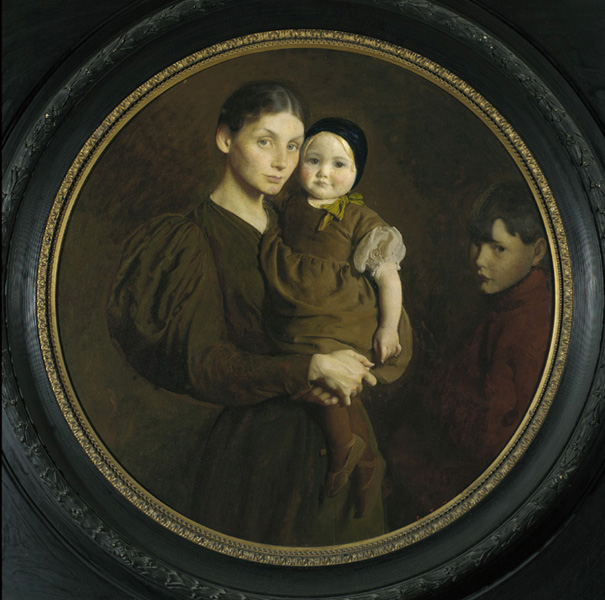
Mother and Child
George de Forest Brush
Active in the American Renaissance movement, George de Forest Brush is best known for portraits of the Madonna and Christ Child. The dozen or so paintings of his wife and children executed in the 1890s established his reputation. Art critics of his day frequently pointed out the Brush's paintings were not mere imitations of Italian religious art but realistic portraits that appealed to contemporary American audiences. Brush was praised for introducing "a modern note of painful seriousness" and avoiding sentimentality.
This portrait of the artist's wife, Mittie, with two of their children, is presented in a tondo, or round format that further emphasizes its relationship to Italian Renaissance paintings by artists such as Raphael and Andrea del Sarto. The portrait's limited range of color, the simple background, and the realistic depiction of facial features link Brush's work not only to Dutch art but also to such popular late nineteenth-century American portrait painters as William Merritt Chase and Thomas Eakins. Their work was often featured in the annual exhibitions at the Pennsylvania Academy, where this painting was awarded a Temple Gold Medal in 1897.
Artist
Date of Birth
(1855-1941)
Date
ca. 1897
Medium
Oil on canvas
Dimensions
39 1/4 x 39 1/4 in. (99.7 x 99.7 cm.), tondo
Accession #
1898.2
Credit Line
Joseph E. Temple Fund
Copyright
No known copyright restrictions
Category
Subject
More by
We're so excited you're planning to visit PAFA!
Make time for art — visit us Thursday to Sunday.
Before reserving your tickets, please review helpful information about museum hours, accessibility, building access, and special admission programs.
If you have any questions, feel free to reach out to us at visitorservices@pafa.org — we’d love to help!