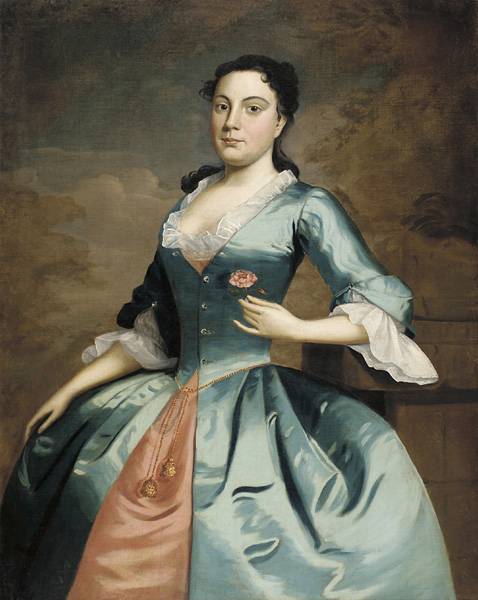
Mary McCall
Robert Feke
Feke is considered the first important American-born artist. He developed a style that was distinct from the prevalent English technique practiced in the Colonies. This “native style” became popular, and Feke earned a living as an itinerant portraitist, traveling between Boston, Philadelphia, and Newport, Rhode Island. Little is known of Feke; his later life is particularly mysterious. After embarking from Newport in 1750, possibly bound for commissions in Barbados, he was never heard from again.
Mary McCall was a member of the Philadelphia Dancing Assembly, which hosted dances every two weeks and was a vital part of the social life of colonial Philadelphia. She holds a single flower, a common device in Feke’s portraits, in this case possibly indicating McCall’s availability for marriage. Seven years after this portrait was thought to have been painted, McCall married the merchant William Plumstead, who served as mayor of Philadelphia in the mid-1750's.
Artist
Date of Birth
(ca. 1707-ca. 1751)
Date
ca. 1746
Medium
Oil on canvas
Dimensions
50 1/4 x 40 1/4 in. (127.6 x 102.2 cm.)
Accession #
1891.3
Credit Line
Bequest of Helen Ross Scheetz
Copyright
No known copyright restrictions
Category
Subject
More by
We're so excited you're planning to visit PAFA!
Make time for art — visit us Thursday to Sunday.
Before reserving your tickets, please review helpful information about museum hours, accessibility, building access, and special admission programs.
If you have any questions, feel free to reach out to us at visitorservices@pafa.org — we’d love to help!