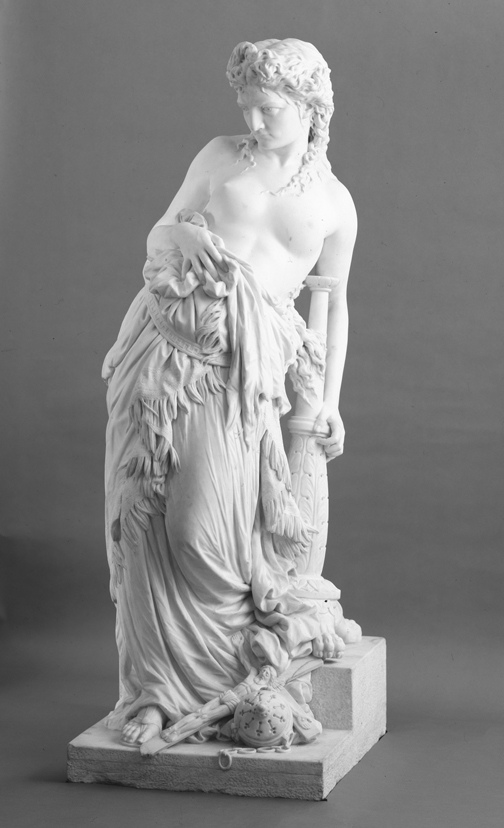
Hypathia
Howard Roberts
A native Philadelphian who had trained at the Pennsylvania Academy, Roberts joined the vanguard of American sculptors when he sailed for France in 1866, choosing Paris over Rome as the place for advanced study. At this time, the Neoclassical style, with its idealized figures and coolly balanced forms, was giving way to a taste for vigorous naturalism - the characteristic manner of the Ecole des Beaux Arts in Paris, and of Roberts's earliest production. This work, Roberts's earliest life-size sculpture, was inspired by Charles Kingsley's 1853 novel, "Hypathia." Set in the city of Alexandria in A.D. 415, the book tells the story of Hypathia, a Neoplatonic philosopher, who upholds the Roman Empire's ancient pagan beliefs and so dies at the hands of a band of monks. For dramatic effect, Roberts depicted the moment when Hypathia, driven into a church, turns to face her enemies. Like a stage director, Roberts provided props for the scene: a crucifix, censer, and candlestick. Scenes depicting such 'threatening' literary heroines enjoyed great popularity in mid-nineteenth century America.
Artist
Date of Birth
(1843-1900)
Date
1873
Medium
Marble; carved in 1877
Dimensions
67 x 23 3/4 x 28 1/2 in. (170.18 x 60.325 x 72.39 cm.)
Accession #
1928.1
Credit Line
Gift of Mrs. Pauline L. Roberts
Copyright
No known copyright restrictions
Category
Subject
We're so excited you're planning to visit PAFA!
Make time for art — visit us Thursday to Sunday.
Before reserving your tickets, please review helpful information about museum hours, accessibility, building access, and special admission programs.
If you have any questions, feel free to reach out to us at visitorservices@pafa.org — we’d love to help!