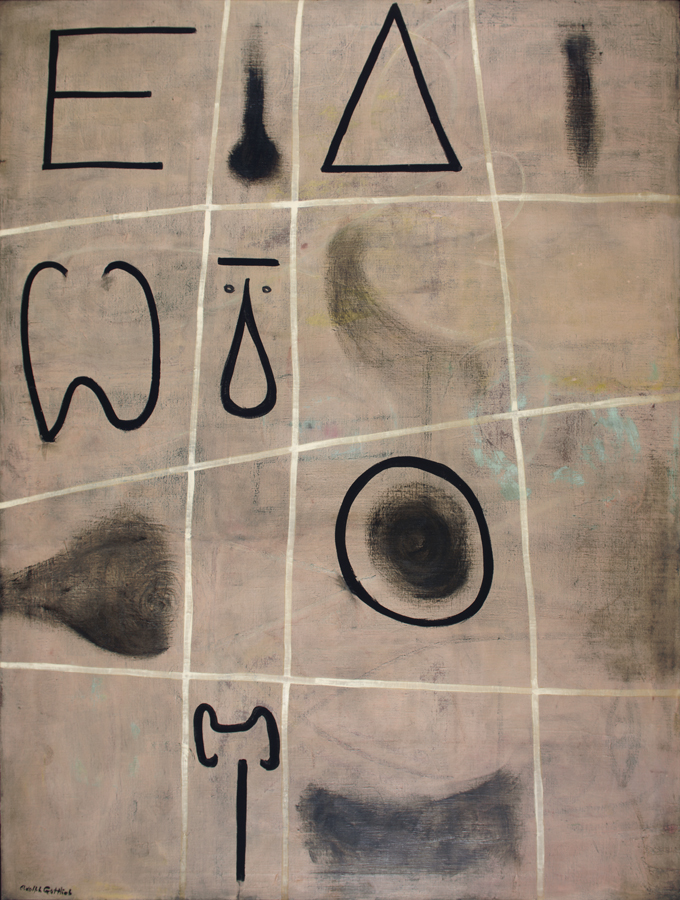
E
Adolph Gottlieb
Adolph Gottlieb left high school in 1920 to enroll in the Art Students League, New York, where he studied with John Sloan. During the 1920s, he traveled to Europe, worked in his father’s business while taking night courses to complete his high school degree, and studied at Parsons School of Design and Cooper Union.
By the late 1930s, Gottlieb moved from gritty realism towards more enigmatic compositions influenced by European Surrealism. Gottlieb’s pictographic painting series, of which E is apart, incorporate grids in which he paints various symbols. E, for example, features a triangular symbol, which might represent the Greek letter delta, a reference to myth and evidence of an interest in pictorial language that concerned Gottlieb and his contemporaries. A stylized human face similar to the “Killroy was here” graffiti left by American soldiers in Europe during World War II can be seen in the second row. Traces of another composition lie beneath the painting and bring to mind the practice of erasing ancient Greek texts in order to re-use vellum for Christian manuscripts during the Medieval period.
Although his work is not as well known as that of his friends Mark Rothko or Barnett Newman, Gottlieb helped shape the philosophy of Abstract Expressionist painting during the 1940s.
Artist
Date of Birth
(1903-1974)
Date
1950
Medium
Oil on canvas
Dimensions
48 x 36 5/8 x 1 3/4 in. (121.92 x 93.0275 x 4.445 cm.)
Accession #
2005.2
Credit Line
Henry C. Gibson Fund
Copyright
© Adolph and Esther Gottlieb Foundation / Licensed by VAGA at Artists Rights Society (ARS), NY
Category
Subject
More by
We're so excited you're planning to visit PAFA!
Make time for art — visit us Thursday to Sunday.
Before reserving your tickets, please review helpful information about museum hours, accessibility, building access, and special admission programs.
If you have any questions, feel free to reach out to us at visitorservices@pafa.org — we’d love to help!