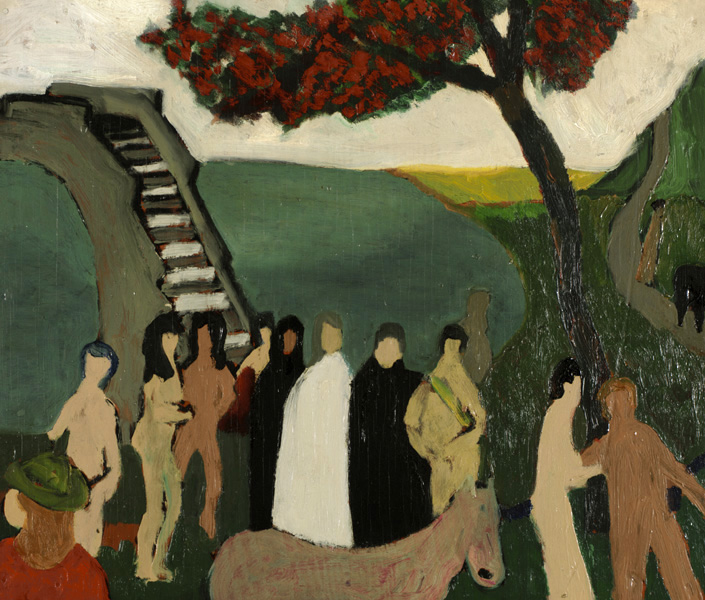
Untitled (Procession at Aqueduct)
Bob Thompson
Envisioning a fantastic world by turns riotous, mysterious, or utopian, Bob Thompson found inspiration in the themes and compositions of Renaissance paintings and the works of the old masters. Equally informed by the color and energy of Paul Gauguin and the German Expressionists, Thompson's deeply personal responses to art historical precedents are typically haunting and complex. He often worked with religious or classical themes, and the inclusion of an aqueduct in this work suggests and ancient Roman setting, as does the interplay of robed and nude figures, evocative of a Roman mystery cult ritual. The figure at lower left, however, with his bright green hat, adds an anachronistic air that threatens to expose the entire scene as theatrical.
Thompson is now recognized as one of the most important African-American painters of the post-war generation, and, indeed, he broke through racial barriers in the art world within his short lifetime. A native Kentuckian, Thompson briefly studied medicine at Boston University before returning to Louisville to study art. He moved to New York in 1959, and became allied with the avant-garde art scene, befriending poets, jazz musicians, and like-minded artists such as Jan Muller, Red Grooms, and Alex Katz who were reinvestigating figurative painting in the wake of Abstract Expressionism. Thompson's work is acclaimed for its emotive colors and interweaving of symbolism, spirituality, and biography: the isolated observer often found in Thompson's work has been identified as self-portrait.
Artist
Date of Birth
(1937-1966)
Date
1961
Medium
Oil on wood panel
Dimensions
20 x 24 in. (50.8 x 60.96 cm.)
Accession #
2000.9
Credit Line
Purchased with Funds provided by the Collectors' Circle
Copyright
© Michael Rosenfeld Gallery LLC, New York, NY, Courtesy of Michael Rosenfeld Gallery LLC, New York, NY
Category
Subject
We're so excited you're planning to visit PAFA!
Make time for art — visit us Thursday to Sunday.
Before reserving your tickets, please review helpful information about museum hours, accessibility, building access, and special admission programs.
If you have any questions, feel free to reach out to us at visitorservices@pafa.org — we’d love to help!