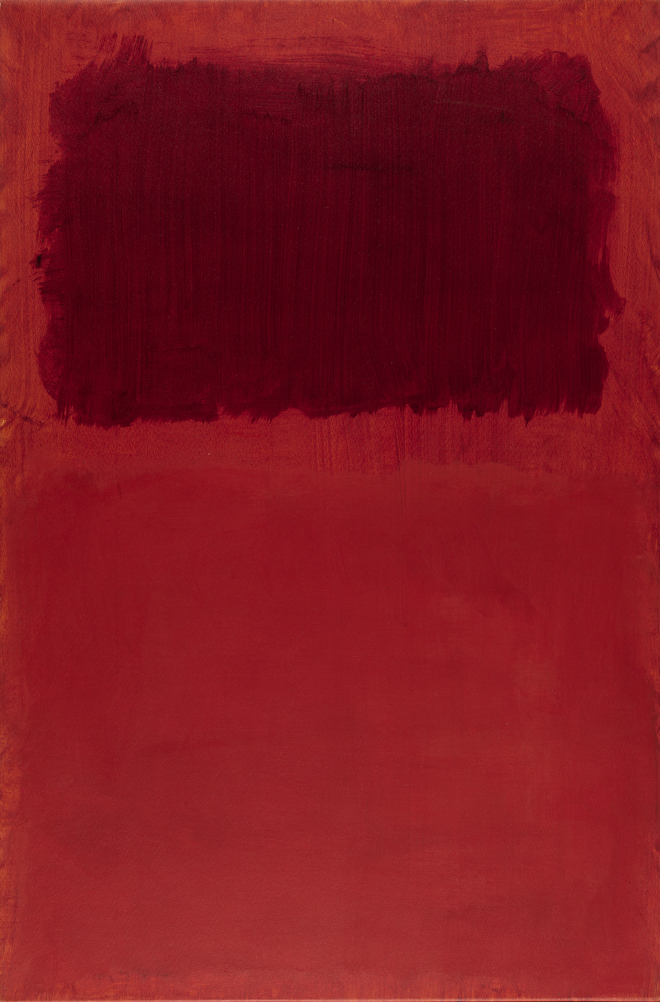
Untitled (Maroon Over Red)
Mark Rothko
One of the most significant artistic pioneers of the postwar period, the Russian-born Rothko is principally associated with Abstract Expressionism but is also considered a forerunner of the Color Field movement, which emerged from the former. Rothko sought to deny the illusion of three-dimensional space, instead making the flatness and physical presence of the canvas an integral component of his work. At the same time, his paintings have been interpreted as profound meditations on the emotive or even transcendent qualities of color. In this light, Rothko's work has been called the most intensely personal of the New York School artists.
Rothko came to the United States as a child, studying briefly at Yale University and at the Art Students League with Max Weber. Rothko moved from representational painting into a period of biomorphic abstraction in the 1930s, informed by the automatic drawing exercises of the Surrealists, ancient myth, and the writings of Feud and Jung. As his work grew increasingly abstract throughout the 1940s, he still pursued a universal response through his work, based on the concept of the collective unconscious. Rothko painted works on paper, such as this one, throughout his career. The translucent washes of paint on absorbent paper accomplish the same hazy, stained effects that are hallmarks of his paint layering technique achieving a compelling luminosity.
Artist
Date of Birth
(1903-1970)
Date
1968
Medium
Acrylic on paper mounted on linen
Dimensions
39 1/8 x 26 in. (99.3775 x 66.04 cm.)
Accession #
1986.31.5
Credit Line
Bequest of Bernice McIlhenny Wintersteen
Copyright
© Kate Rothko Prizel & Christopher Rothko / Artists Rights Society (ARS), New York
Category
Subject
More by
We're so excited you're planning to visit PAFA!
Make time for art — visit us Thursday to Sunday.
Before reserving your tickets, please review helpful information about museum hours, accessibility, building access, and special admission programs.
If you have any questions, feel free to reach out to us at visitorservices@pafa.org — we’d love to help!