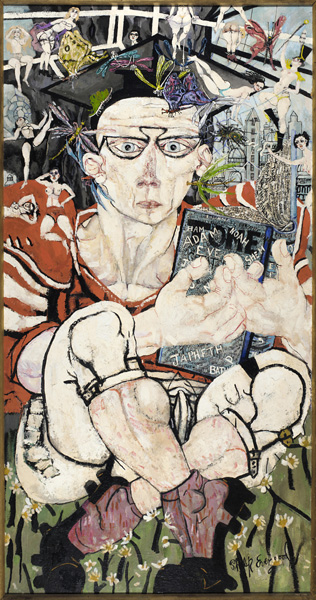
Threshold to Success
Philip Evergood
Born in New York City as Philip Blashki, Evergood moved with his family to London when he was a child. To avoid prejudice there, his name was legally changed to Evergood at the age of thirteen. A musician in his youth, he studied at Eton and Cambridge University before beginning his art education at the Slade School. Returning to New York in 1923, Evergood’s early work engaged biblical themes but with the onset of the Depression he shifted to Social Realism, focusing on political oppression and racism in several impressive murals painted for the WPA. Politically active, Evergood served as president of the New York Artists Union.
In the 1950s, Evergood turned to images that combined fantasy with biblical and mythological symbolism. A prime example of this later style, "Threshold to Success"started as a demonstration for students in a summer class but evolved into a painting depicting the erotic dreams of a young athlete-turned-scholar. He holds a large book bearing the title "Tome" that has a multitude of names inscribed upon it. Most prominent are the names of Old Testament figures such as Adam, Ham, and Noah, but these names coexist with a great array of other allusions, including Orphan Annie, Piet Mondrian, Betsy Ross, Hippocrates, and Edouard Vuillard.
Artist
Date of Birth
(1901-1973)
Date
1955-1957
Medium
Oil on gessoed celotex board
Dimensions
67 1/2 x 36 1/4 in. (171.45 x 92.075 cm.)
Accession #
1958.10
Credit Line
Joseph E. Temple Fund
Copyright
© artist or artist’s estate
Category
Subject
We're so excited you're planning to visit PAFA!
Make time for art — visit us Thursday to Sunday.
Before reserving your tickets, please review helpful information about museum hours, accessibility, building access, and special admission programs.
If you have any questions, feel free to reach out to us at visitorservices@pafa.org — we’d love to help!