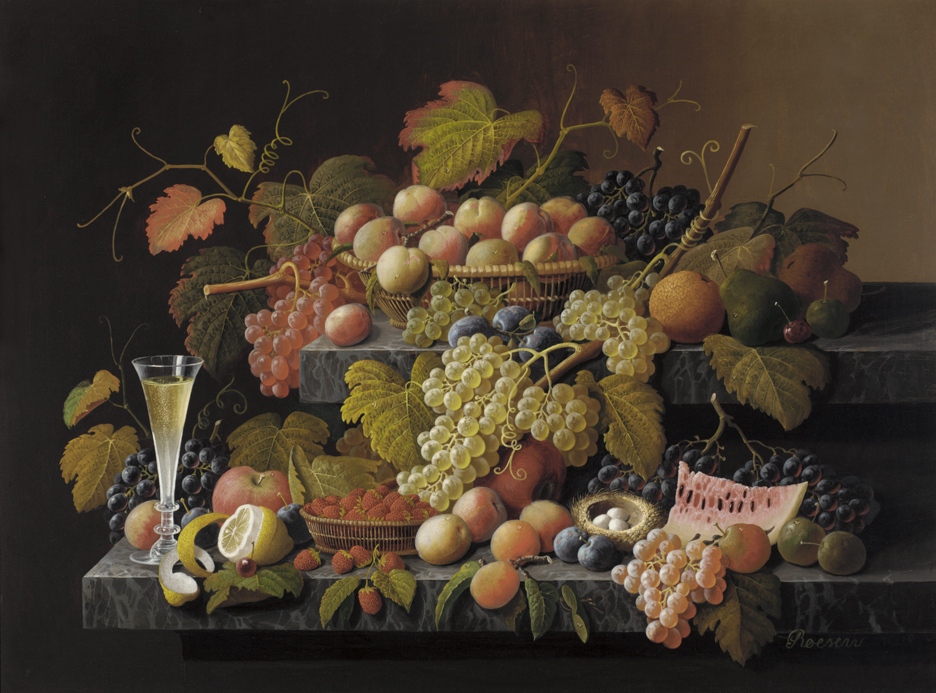
Still Life with Fruit
Severin Roesen
Trained as a china- and enamel painter in his native Germany, Severin Roesen emigrated to the United States during the 1848 Revolution. He settled fist in New York before moving to Williamsport, Pennsylvania. Located in the north central part of the state, Williamsport was a wealthy city in nineteenth-century America because of its abundance of lumber. Around the middle of the century, the city boasted more millionaires per capita than any other locale, making it a lucrative market for an enterprising artist. This painting, executed three years after Roesen came to Pennsylvania, displays the characteristics that made Roesen a success in his adopted country. The warm tones and profusion of meticulously rendered fruits spilling forth from wicker baskets recall the grand still life tradition of seventeenth-century Dutch painting, a genre always popular with collectors, both in Europe and America. But while such paintings often contained symbolic messages warning of the transience of life, Roesen's updated composition is a richly detailed celebration of the bounty and variety of nature. The two-tier arrangement and bird's nest appear in several of Roesen's other paintings, while its large scale (over three feet in length) lent itself to the grand interiors of the luxurious homes being built in the prosperous city.
Artist
Date of Birth
(1815/16-1872 or after)
Date
ca. 1855
Medium
Oil on canvas
Dimensions
30 1/8 x 40 1/8 in. (76.5175 x 101.9175 cm.)
Accession #
1976.4
Credit Line
Gift of William C. Williamson, by exchange, and Henry S. McNeil and the Henry D. Gilpin Fund
Copyright
No known copyright restrictions
Category
Subject
More by
We're so excited you're planning to visit PAFA!
Make time for art — visit us Thursday to Sunday.
Before reserving your tickets, please review helpful information about museum hours, accessibility, building access, and special admission programs.
If you have any questions, feel free to reach out to us at visitorservices@pafa.org — we’d love to help!