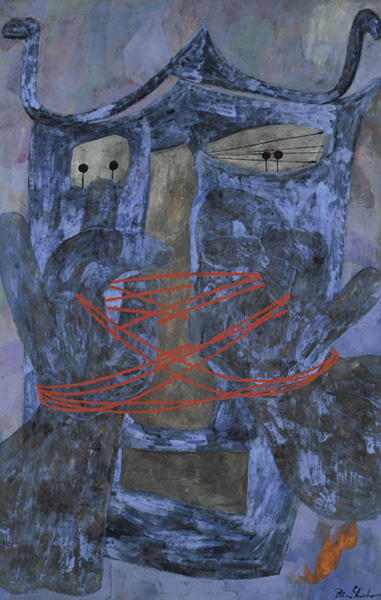
Cat's Cradle in Blue
Ben Shahn
Although Ben Shahn is strongly identified as an artist committed to social and political causes, his work never reads as mere propaganda, but resounds with deeply felt humanitarian concerns for the individual in society, and the plight of the oppressed. Born in Kovno, Lithuania, Shahn's family emigrated to Brooklyn in 1906. At an early age, he apprenticed with a lithographer and later studied at the National Academy of Design and the Art Students League. His vigorous artwork was influenced by the European avant-garde, American naive painting, and the Mexican muralists. Shahn designed his own murals during the Depression working for government relief agencies, for which he also photographically documented rural poverty. Such experiences filtered into Shahn's art.
Not all of Shahn's artwork was overtly political. Later in his career he designed sets for theater and ballets. The strange "primitive" figure in "Cat's Cradle in Blue" derives from a mask of the devil Shahn designed in 1958 for the poet Archibald MacLeish's controversial Pulitzer Prize-winning verse drama "J.B.," based on the Book of Job. The bizarre figure, with its double-pupil eyes, reappears in a later work, "Branches of Water or Desire" (1965). Likewise, Shahn explored the visually dazzling game of cat's cradle, both as simple play and with deeper symbolic meaning, in several drawings, prints, posters, and paintings throughout his career.
Artist
Date of Birth
(1898-1969)
Date
ca. 1959
Medium
Egg tempera on composition board
Dimensions
39 3/4 x 25 3/4 in. (100.965 x 65.405 cm.)
Accession #
1960.11
Credit Line
Joseph E. Temple Fund
Copyright
© Estate of Ben Shahn / Licensed by VAGA at Artists Rights Society (ARS), NY
Category
Subject
More by
We're so excited you're planning to visit PAFA!
Make time for art — visit us Thursday to Sunday.
Before reserving your tickets, please review helpful information about museum hours, accessibility, building access, and special admission programs.
If you have any questions, feel free to reach out to us at visitorservices@pafa.org — we’d love to help!