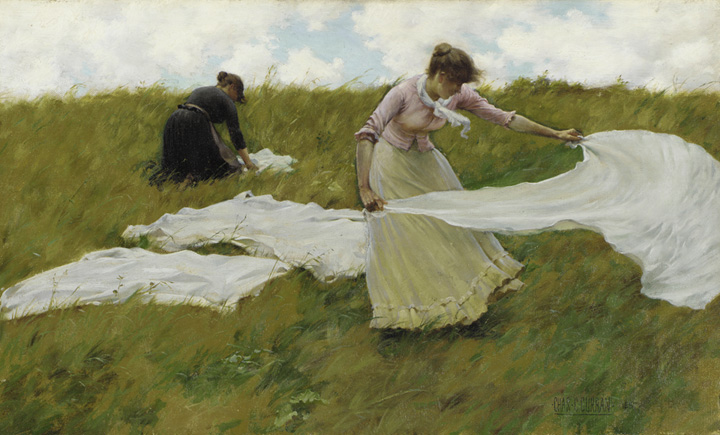
A Breezy Day
Charles C. Curran
Charles C. Curran might have been familiar with the lively rituals of laundry day in the country, having grown up in Kentucky and lived in Ohio in his early twenties, where he attended art school at the Cincinnati School of Design before moving East. When exhibited at the National Academy of Design in 1888, this painting won the Hallgarten Prize for a work in oil. After the success of this painting and exhibitions at the Pennsylvania Academy and the Brooklyn Academy of Art, Curran continued his studies at the Académie Julian, one of the most important Parisian studios for young American artists. In France, Curran came in contact with Impressionism and the popular peasant paintings of Jules Bastien-LePage. Both tendencies marked his style from then on, as his mature work frequently featured airy, luminous scenes of outdoor life, often with female subjects. A popular teacher at the National Academy of Design in New York and an active member of the Cragsmoor Art Colony in upstate New York during the last several decades of his life, Curran exhibited widely throughout his career, winning medals at the 1893 Columbian Exposition, the 1900 Paris Expositions, and the Pan-American Exposition in Buffalo in 1901.
Artist
Date of Birth
(1861-1942)
Date
1887
Medium
Oil on canvas
Dimensions
11 15/16 x 20 in. (30.32125 x 50.8 cm.)
Accession #
1899.1
Credit Line
Henry D. Gilpin Fund
Copyright
No known copyright restrictions
Category
Subject
More by
We're so excited you're planning to visit PAFA!
Make time for art — visit us Thursday to Sunday.
Before reserving your tickets, please review helpful information about museum hours, accessibility, building access, and special admission programs.
If you have any questions, feel free to reach out to us at visitorservices@pafa.org — we’d love to help!